
Seeing the DF049 fault code pop up on your Renault’s diagnostic scanner can be confusing. Unlike standard OBD-II codes that point to a single issue, DF049 is a manufacturer-specific Renault code that can indicate completely different problems depending on your vehicle model and which system flagged it. The code has been linked to air conditioning failures, automatic transmission malfunctions, and even AdBlue system errors on newer diesel models.
This guide breaks down every known meaning of the DF049 code, walks you through the symptoms you should watch for, and provides step-by-step diagnostic and repair procedures. Whether you are a DIY mechanic or preparing for a trip to the dealership, you will know exactly what to expect.
What Is the DF049 Renault Fault Code?
The DF049 code is part of Renault’s proprietary diagnostic trouble code (DTC) system. Renault uses a “DF” prefix for manufacturer-specific codes that are read through their dedicated CLIP diagnostic software or compatible third-party scanners. Unlike universal P-codes defined by the OBD-II standard, DF codes are unique to Renault vehicles and can carry different definitions depending on which electronic control unit (ECU) stores them.
The DF049 code has been documented with at least three distinct definitions across Renault’s model range. The most widely reported definition relates to the refrigerant pressure sensor circuit in the air conditioning system, typically logged as a short circuit to ground. The second major definition involves the transmission pressure regulation memory fault in vehicles equipped with DPO (DP0) or AL4 automatic gearboxes. A third, less common definition points to an AdBlue dosing module communication fault on newer diesel-powered commercial vehicles.
Understanding which definition applies to your specific vehicle is the critical first step in any diagnostic process. The symptoms your vehicle displays, the warning lights on the dashboard, and the specific ECU that logged the code will all help narrow down the root cause.
DF049 Meanings by System
1. Air Conditioning System: Refrigerant Pressure Sensor Circuit
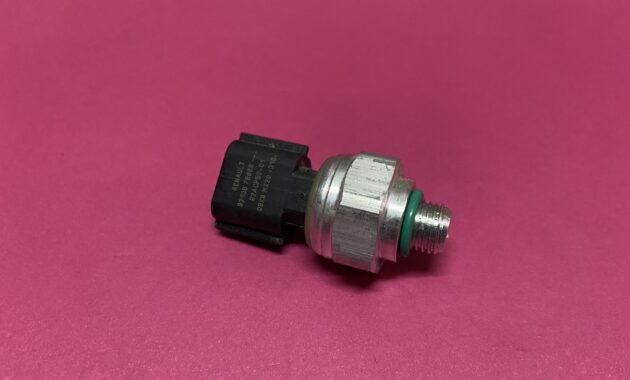
This is the most common interpretation of the DF049 code. The full description typically reads “Refrigerant pressure sensor — short circuit to ground” or a similar variation. The air conditioning system in your Renault relies on a pressure transducer to monitor refrigerant levels. This sensor uses a three-wire configuration consisting of a 5-volt reference supply, a signal wire, and a ground wire. When the ECU detects an abnormal voltage reading from this circuit, usually a signal that has dropped to near zero, it triggers the DF049 code and disables the AC compressor as a protective measure.
The AC pressure sensor is typically located on the high-pressure refrigerant line, often mounted between the condenser and the receiver drier. On models like the Megane II, the sensor sits on the tube exiting the AC condenser near the front of the engine bay.
2. Automatic Transmission: Pressure Regulation Memory Fault
On Renault vehicles equipped with the DPO (DP0) automatic transmission, also known as the AL4 in Peugeot and Citroën vehicles, the DF049 code can indicate a pressure regulation memory fault. This code is triggered when the transmission control module detects a discrepancy between the calculated line pressure and the actual measured pressure inside the gearbox. The DPO transmission uses a pressure regulation solenoid and an oil pressure sensor to maintain proper hydraulic pressure during gear changes.
When this fault occurs, the transmission typically enters what Renault calls “degraded mode” or limp mode, locking the gearbox into third gear. This is a protective mechanism designed to prevent further damage to the transmission internals. Drivers usually notice this as a sudden loss of power or an inability to shift through all gears normally.
3. AdBlue System: Dosing Module Communication Error
On newer Renault diesel models, particularly the Master III and Trafic III, the DF049 code can appear in relation to the AdBlue exhaust aftertreatment system. In this context, the code indicates a communication failure between the AdBlue dosing module and the engine management computer. The dashboard may display a “check exhaust system” warning alongside the engine warning light.
Common Symptoms of the DF049 Code
The symptoms you experience depend entirely on which system has triggered the fault. Here is a breakdown of what to watch for in each scenario.
AC-Related Symptoms
The most obvious sign is that your air conditioning stops working entirely. The compressor clutch will not engage, the blower may still operate but only pushes ambient-temperature air, and you may not hear the typical click of the compressor cycling on. In some cases, the AC may work intermittently before failing completely. On certain Renault models, a general electrical warning light may also illuminate on the dashboard.
Transmission-Related Symptoms
Transmission-linked DF049 codes produce more dramatic symptoms. You may notice harsh or delayed gear shifts, the transmission getting stuck in third gear (limp mode), a flashing snowflake or sport mode indicator on the dashboard, or a “Transmission Fault” message on the instrument cluster. These symptoms often appear intermittently at first, sometimes resolving after the engine is restarted, but they tend to become more frequent over time. When the gearbox is cold, shifting may work normally, but problems emerge once the transmission fluid reaches operating temperature.
AdBlue-Related Symptoms
AdBlue system faults trigger the engine warning light and a “check exhaust system” message. In severe cases, the vehicle may enter a restricted performance mode that limits engine power. If the fault persists without repair, some vehicles may refuse to restart after a set number of ignition cycles.
Renault Models Affected by DF049
The DF049 code has been reported across a wide range of Renault vehicles. Here is a summary of the most commonly affected models and the system typically involved.
AC pressure sensor related: Megane II (2002–2008), Megane III (2008–2016), Clio II (1998–2012), Clio III (2005–2014), Scenic II (2003–2009), Laguna II (2001–2007), Modus (2004–2012).
Transmission pressure regulation related: Clio II with DPO gearbox (2001–2006), Megane Scenic with DPO (1999–2003), Laguna II with DPO (2001–2007), Megane II with DPO (2002–2008).
AdBlue system related: Master III 2.3 dCi (2010–present), Trafic III 1.6 dCi (2014–2019).
It is worth noting that the DF049 code is also found on vehicles using Renault-sourced engines, including certain Nissan and Dacia models such as the Nissan Note 1.5 dCi and the Dacia Duster.
How to Diagnose the DF049 Fault Code
Accurate diagnosis starts with a proper scan using a tool that can read Renault-specific DF codes. Generic OBD-II code readers may not display the code at all, or they may show it without the full fault description. Here are the recommended diagnostic tools and the steps to follow.
Recommended Diagnostic Tools
Renault CLIP is the factory-level diagnostic software and provides the most detailed information, including live data streams, fault context, and full code descriptions. Third-party alternatives that support Renault DF codes include the Delphi DS150e, iCarsoft CR MAX, and the Launch X431 series. A basic OBD-II reader may display the code number but will lack the context needed for accurate diagnosis.
Step-by-Step Diagnostic Process
Step 1: Connect the diagnostic scanner and read all stored fault codes across every ECU. Pay attention to which module logged the DF049 code: the engine/injection ECU, the climate control module, or the transmission control module. This immediately tells you which system is affected.
Step 2: Note whether the code is flagged as “present” or “stored.” A present fault indicates the problem exists right now. A stored fault means the issue occurred previously but may not be active. However, intermittent faults should not be ignored.
Step 3: Review any companion fault codes. The DF049 code rarely appears in isolation. For AC-related issues, you might also see codes for the 5-volt sensor supply circuit. For transmission issues, codes like DF005 (oil pressure sensor circuit), DF018 (pressure modulating solenoid), or DF036 are often present alongside DF049.
Step 4: Access live data for the relevant system. For AC diagnostics, monitor the refrigerant pressure sensor voltage. The expected reading at idle with AC off is approximately 0.8 volts, rising to around 2.2 volts with the AC engaged. For transmission diagnostics, monitor the line pressure readings. Expected values at idle in Neutral should be between 2.4 and 2.8 bar, and in Drive between 2.8 and 3.1 bar.
Step 5: Perform a visual inspection of the relevant sensor, wiring harness, and electrical connectors before replacing any components.
Fixing DF049: Air Conditioning Pressure Sensor
If your diagnostic scan confirms that DF049 is related to the air conditioning system, follow these steps to locate and resolve the problem.
Check the Sensor and Wiring
Locate the AC pressure sensor on the high-pressure refrigerant line near the condenser. On most Renault models, this is a small, cylindrical sensor with a three-pin electrical connector. Inspect the connector for signs of corrosion, oxidation, or moisture damage. Corroded contacts are one of the most frequent causes of DF049 in the AC system, especially on older vehicles or those driven in humid climates. In one well-documented case involving a Megane II, simply cleaning the rusted contacts on both the sensor and its plug restored full AC operation.
Check the wiring harness between the sensor and the ECU for any signs of chafing, broken insulation, or pinched wires. Use a multimeter to verify that the sensor receives a stable 5-volt reference supply and has a proper ground connection. If the 5-volt reference is missing, the problem may lie upstream in the ECU or the shared sensor supply circuit.
Test the Sensor Output
With the sensor plugged in and the ignition on, measure the voltage on the signal wire. A reading near 0 volts when it should be around 0.8 volts strongly suggests a faulty sensor or a short circuit to ground in the wiring. If the 5-volt supply and ground are confirmed good but the signal output remains abnormal, the sensor itself is most likely defective and should be replaced.
Replace the Sensor
On many Renault models, the AC pressure sensor is mounted on a Schrader valve fitting, which means you can replace the sensor without evacuating the refrigerant from the system. However, it is important to verify this for your specific model before removing the old sensor. The replacement part number for many Renault applications is 7700417506 or its updated equivalent 7701205751. The sensor typically uses a 3/8-24 UNF thread and is compatible with R134a refrigerant systems.
Verify Refrigerant Charge
If the sensor and wiring check out fine, the problem may be related to the actual refrigerant pressure. An empty or critically low refrigerant charge will produce abnormal pressure readings that trigger the DF049 code. Have the system inspected for leaks using a UV dye test or electronic leak detector, and recharge the system to the manufacturer-specified level if needed.
Fixing DF049: Transmission Pressure Regulation
Transmission-related DF049 codes require more careful diagnosis because multiple components can be responsible. The DPO/DP0 automatic gearbox found in many Renault models from the early 2000s is known for pressure regulation issues, and the DF049 code specifically flags a problem with the pressure regulation memory.
Check the Transmission Fluid
Start with the basics. Verify that the transmission fluid level is correct and that the fluid is in acceptable condition. Low fluid levels directly cause low hydraulic pressure, which triggers pressure regulation faults. Dark, burnt-smelling fluid indicates overheating and degradation, which increases internal leakage. The DPO transmission is notoriously sensitive to fluid quality, and many experts recommend changing the fluid every 60,000 km despite Renault’s “sealed for life” claim.
Inspect the Pressure Regulation Solenoid
The pressure regulation solenoid, also called the EVM solenoid, is located inside the valve body. This solenoid controls the main line pressure in the transmission. A faulty solenoid causes the ECU to detect a mismatch between requested and actual pressure, triggering DF049 and forcing the gearbox into limp mode. You can test the solenoid by measuring its resistance, which should be approximately 1.2 ohms. Also verify that it actuates properly when supplied with 12 volts.
Test the Oil Pressure Sensor
The external oil pressure sensor is a disc-shaped component bolted to the bottom of the transmission housing. It can be accessed without removing the gearbox. This sensor provides the actual pressure reading to the transmission ECU. A faulty sensor will send incorrect pressure data, causing the DF049 code even if the actual hydraulic pressure is within normal limits. The sensor should show approximately 20 kOhm resistance when the engine is off.
Check the Valve Body
Internal leaks within the valve body or between the valve body and the transmission housing can cause genuine pressure drops. If replacing the solenoid and sensor does not clear the fault, the valve body may need to be inspected for wear, scoring, or seal damage. In some cases, a gasket leak between the valve body and the transmission casing is the root cause.
Reset Adaptive Parameters
After completing any transmission repair, it is essential to reset the DPO self-adapting parameters using a Renault CLIP or equivalent diagnostic tool. The transmission ECU uses adaptive shift and pressure regulation values that must be recalibrated after component replacement. Without this reset, the old faulty parameters may cause the code to return or create new shifting problems.
Fixing DF049: AdBlue Dosing Module
On Renault Master III and Trafic III models, the DF049 code pointing to AdBlue dosing module communication failure requires a systematic approach.
Check the wiring and connectors between the AdBlue dosing module and the engine management ECU. Look for damaged wires, corroded pins, or loose connectors. Verify that the module is receiving proper power supply and ground.
Inspect the AdBlue system components, including the dosing injector, the NOx sensors (upstream and downstream of the catalytic converter), and the AdBlue heater circuit. A fault in any of these components can cause cascading communication errors.
If no wiring issues are found, the AdBlue dosing module itself may need replacement. This is a significant repair that can be costly. When replacing the module, ensure the replacement unit matches the original part number exactly and that the module calibration data is properly transferred or configured using the diagnostic software.
Estimated Repair Costs
Repair costs for the DF049 code vary significantly depending on which system is affected and whether you perform the work yourself or visit a professional mechanic.
AC pressure sensor replacement: The sensor part itself ranges from $30 to $80 for aftermarket options and up to $150 for a genuine Renault part. Professional labor adds $100 to $200. If the system needs to be evacuated and recharged with refrigerant, expect an additional $100 to $250. Total professional repair cost: approximately $230 to $450.
Transmission pressure regulation repair: Replacing the pressure regulation solenoid costs around $50 to $120 for the part. The oil pressure sensor runs $40 to $100. Labor for valve body removal and solenoid replacement typically costs $200 to $400. If a full valve body replacement is needed, total costs can reach $500 to $900. Transmission fluid replacement adds another $80 to $150.
AdBlue dosing module replacement: The module alone can cost $400 to $800 depending on the source. Labor for replacement and programming adds $200 to $400, bringing the total to $600 to $1,200 or more.
How to Prevent DF049 From Recurring
Taking a few preventive measures can significantly reduce the likelihood of seeing the DF049 code again.
Maintain your AC system annually. Have the refrigerant level checked and topped up as part of your regular service schedule. Address any slow leaks before they cause the pressure to drop below the sensor threshold. Keep the condenser clean and free of debris to prevent excessive system pressures.
Service your DPO transmission regularly. Despite Renault’s “sealed for life” label, experienced transmission specialists strongly recommend changing the ATF every 60,000 to 80,000 km. The DPO/AL4 gearbox generates significant heat, and degraded fluid directly contributes to pressure regulation problems. Also check that the transmission oil cooler is functioning properly, as inadequate cooling accelerates fluid breakdown and clutch wear.
Inspect electrical connections during routine service. Corrosion and loose connectors are among the top causes of sensor-related fault codes. Apply dielectric grease to sensor connectors after cleaning to prevent moisture intrusion and oxidation.
Address warning signs early. Intermittent AC failures, occasional harsh gear shifts, or briefly illuminated warning lights are early indicators that a problem is developing. Catching these issues before they become persistent faults is always cheaper and easier than dealing with a fully failed component.
Frequently Asked Questions
What does the DF049 fault code mean on a Renault?
The DF049 fault code is a manufacturer-specific Renault DTC that can indicate different problems depending on the vehicle model. It most commonly points to an AC refrigerant pressure sensor circuit fault, a transmission pressure regulation memory fault in DPO/AL4 automatic gearboxes, or an AdBlue dosing module communication error on diesel commercial vehicles like the Master III.
Can I drive my Renault with the DF049 fault code?
If the code is AC-related, you can drive safely but your air conditioning will not work. If the code is transmission-related, the vehicle may enter limp mode and restrict you to third gear, which makes driving possible but significantly limited in terms of speed and acceleration. Prompt diagnosis is recommended in all cases to prevent further damage to the affected system.
How much does it cost to fix the DF049 fault code on a Renault?
Costs range widely. An AC pressure sensor replacement runs between $230 and $450 including labor and refrigerant recharge. Transmission repairs involving the pressure regulation solenoid or oil pressure sensor cost between $300 and $900. AdBlue dosing module replacement on the Renault Master can exceed $800 to $1,200 depending on parts sourcing and labor rates in your area.
Which Renault models are most affected by the DF049 code?
The AC-related variant is most common on the Megane II, Megane III, Clio II, Clio III, Scenic, and Laguna. Transmission-related DF049 codes primarily affect models with the DPO automatic gearbox, including the Clio II, Megane, Scenic, and Laguna from the early-to-mid 2000s. The AdBlue-related variant appears on the Master III and Trafic III diesel models.
How do I diagnose the DF049 fault code on my Renault?
Connect a Renault-compatible diagnostic scanner such as CLIP, Delphi DS150e, or iCarsoft CR MAX. Read the full code description and note which ECU logged it to determine whether the fault is AC, transmission, or AdBlue related. Then inspect the relevant sensor, wiring, and connectors for damage before replacing any components. Always check live data readings against manufacturer specifications to confirm the actual fault before ordering parts.